

When a miner shuts down due to overheating, it often feels sudden. But in reality, cooling failure rarely happens all at once. It develops slowly — through dust buildup, airflow restriction, rising ambient temperature, or fan degradation. At IceRiver, cooling stability is treated as a long-term engineering priority because gradual thermal stress is one of the biggest hidden threats to mining uptime.
👉 Explore IceRiver ASIC miners:
https://www.iceriver.app/collections/iceriver-miners
Why Cooling Problems Start Small
Mining hardware runs under continuous load. Even small inefficiencies compound over time.
Common early-stage issues:
- Minor dust buildup
- Slightly restricted airflow
- Gradual fan wear
- Seasonal ambient temperature rise
- Improper rack spacing
None of these cause instant failure — but together, they increase operating temperature week after week.
The Gradual Warning Signs Most Miners Miss
Before overheating causes shutdown, you’ll usually see:
- Rising average temperatures
- Higher fan RPM over time
- Slight performance throttling
- Occasional automatic restarts
- Reduced stability during peak heat
These signals often appear subtle — but they’re early indicators of airflow imbalance.
How Heat Accumulates Over Time
Cooling systems rely on consistent airflow. If airflow drops even slightly:
- Internal heat builds faster than it escapes
- Chip temperatures slowly rise
- Electrical resistance increases
- Fans work harder to compensate
Eventually, the system reaches a tipping point.
What feels like a sudden shutdown is actually the final stage of a slow decline.
Comparison: Gradual Cooling Decline vs Sudden Failure
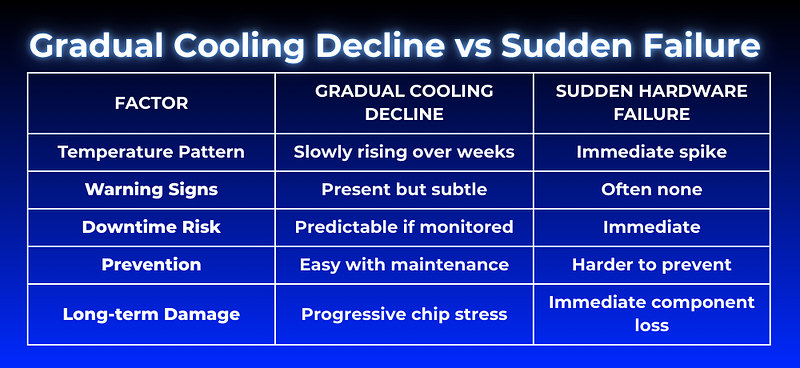
Most overheating events fall into the left column.
Dust: The Silent Performance Killer
Dust rarely causes immediate overheating. Instead, it:
- Reduces airflow incrementally
- Traps heat around hashboards
- Forces fans to run at higher speeds
- Accelerates mechanical wear
IceRiver miners are engineered with optimized airflow channels, but even well-designed hardware benefits from controlled environments.
👉 Learn about IceRiver hosting environments:
https://www.iceriver.app/pages/hosting
Professional hosting reduces dust exposure and airflow obstruction significantly.
Fan Wear and Thermal Drift
Cooling systems depend on mechanical components. Over time:
- Bearings degrade
- RPM efficiency drops
- Air pressure decreases
- Vibration increases
Fan degradation is gradual — rarely immediate — which is why continuous monitoring matters.
Home Mining vs Professional Hosting Cooling Stability
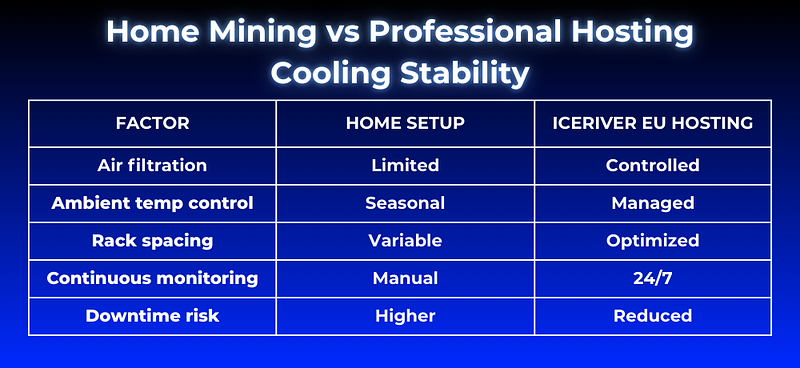
Hosting environments are designed to minimize gradual cooling deterioration.
IceRiver’s Cooling Philosophy
IceRiver miners are built with:
- Balanced internal component spacing
- Directed airflow channels
- Stable power delivery
- Thermal efficiency under 24/7 load
This reduces stress on components and helps prevent the slow thermal degradation that leads to downtime.
👉 View IceRiver miner lineup:
https://www.iceriver.app/collections/iceriver-miners
Why Monitoring Matters More Than Reaction
Cooling failure is rarely dramatic at first.
Preventive steps include:
- Regular temperature checks
- Watching for rising fan speeds
- Maintaining clean airflow paths
- Ensuring proper spacing between units
Cooling stability is about consistency, not crisis management.
The Real Cost of Ignoring Gradual Cooling Issues
When slow thermal stress is ignored, it leads to:
- Reduced efficiency
- Increased downtime
- Higher maintenance costs
- Shortened hardware lifespan
- Delayed ROI
Long-term mining success depends on sustained performance — not peak performance.
Conclusion
Cooling failure rarely happens all at once. It develops gradually through small, manageable issues.
At IceRiver, miner design and hosting infrastructure focus on long-term thermal balance because stability always outperforms reaction in professional mining.
Efficient airflow, controlled environments, and proactive monitoring prevent the slow buildup that causes sudden shutdowns.
🔗 Stay Connected
📱 Instagram
📘 Facebook
🎥 YouTube
📱 TikTok
📢 Twitter